

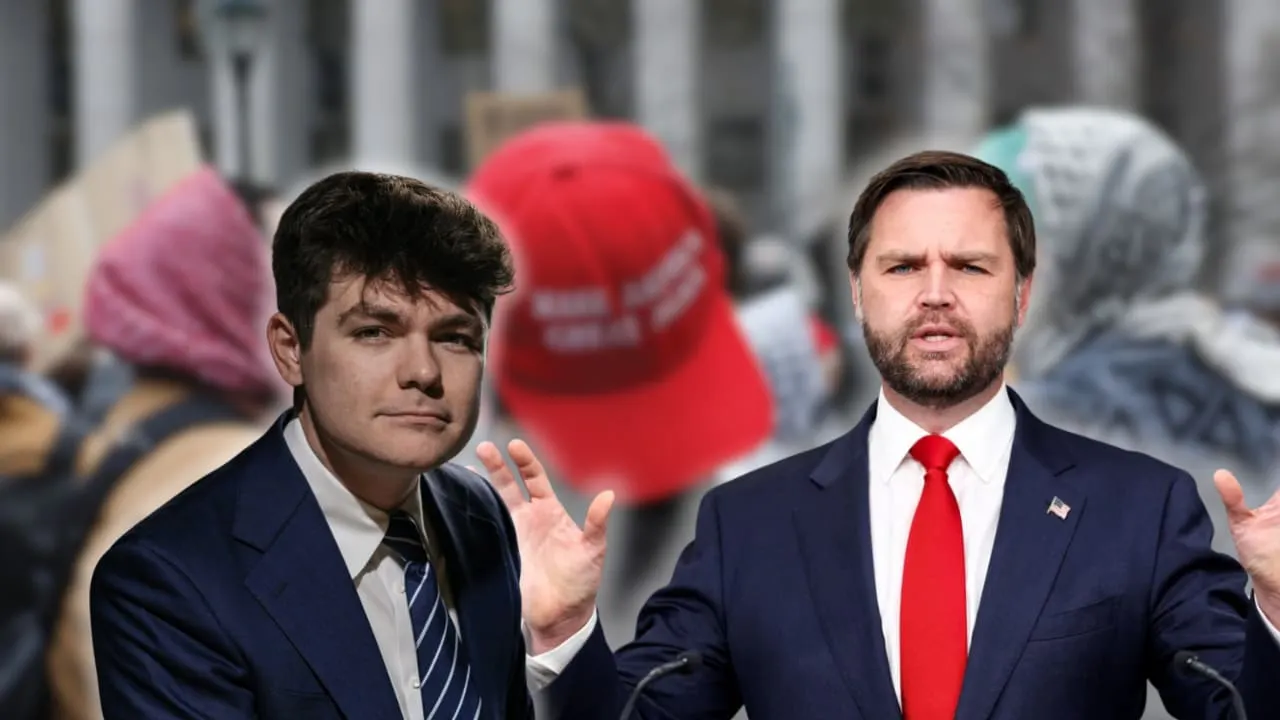
Nick Fuentes is right about J.D. Vance in one respect. Michael Weiss observed, dismally, that Fuentes had supplied The New York Times article’s “most honest quote” about the vice president. Ben Shapiro underscored the point by replying with an image captioned, “Heartbreaking: The Worst Person You Know Just Made A Great Point.” Fuentes’s point was that Vance panders to the far right while declining the baggage of being identified with it. This is not a compliment from a man whose politics are an open sewer of racial and antisemitic hatred. It is an indictment. Vance has confused access to an audience with an obligation to accommodate the people who inflame it.
Vance’s relationship with Tucker Carlson is a public and politically consequential alliance, not an obscure association unearthed by opposition researchers. Carlson elevated Vance during his 2022 Senate campaign and pressed Donald Trump to select him as vice president in 2024. Vance calls Carlson a friend, concedes they have disagreements, and argues that a podcaster with millions of listeners cannot be cast outside conservatism merely because people dislike his views.
That proposition is evasive and revealing. The question is whether a movement retains any moral or intellectual boundary at all. Carlson’s popularity does not absolve him of cordially platforming Fuentes, an influencer who makes jokes and remarks about the Holocaust in ways that cast doubt on whether it occurred. It does not erase his hosting of Holocaust apologists or make smears of Jews and conspiratorial insinuations about Israel a mere disagreement among friends. These are judgments about fellow citizens, historical truth, and the legitimacy of hatred.
The vice president’s answer, delivered to the Republican Jewish Coalition, was the answer of a man who wishes to preserve every option. Asked where he draws the line on appearing with figures including Carlson, Rogan, and Fuentes, Vance declined to address Carlson. He said he would not speak to a man who had attacked his wife or said Hitler was good, but that, outside a few “bright lines,” he tries to speak to as many people as possible.
This is not moral seriousness. It is moral idiocy, because it establishes a grotesque hierarchy of offense. A personal attack on the vice president’s wife is, rightly, beyond the pale. But a powerful friend can circulate anti-Jewish smears, host Holocaust apologists, and lend credence to the false conspiracy theory that Israel knew of the 9/11 attacks in advance and concealed the knowledge from America, and Vance cannot bring himself to say the friendship has reached a bridge too far. What, exactly, are his bright lines bright enough to illuminate? They appear to become visible only when the insult arrives at his own doorstep.
A national leader should not need a family grievance to recognize a moral obscenity. Fuentes does not become unacceptable because he insulted Usha Vance. He is unacceptable because he makes a political project of degrading Jews, minorities, women, and the constitutional idea of equal citizenship. Carlson does not become beyond criticism merely because he supported the Republican ticket. He becomes a grave problem when he uses a vast platform to dignify the undignified and then treats objections as proof of an establishment conspiracy.
This is where the influencer class deserves the contempt it has earned. Its vice is not that it is right wing, left wing, populist, libertarian, or contrarian. It has made transgression into a business model and cowardice into a pose of bravery. The influencer makes the offense itself the product, converts outrage into attention and subscriptions, then calls the predictable disgust censorship. Every boundary becomes a challenge. Every rebuke becomes content.
It is also a profoundly thoughtless class, one that mistakes risk-free provocation for courage. Most influencers will say the outrageous thing if it flatters their audience or enrages a designated enemy. They seldom take a genuinely controversial stand when the target is a profitable ally, a fellow traveler, or a host with a larger platform. Ben Shapiro, and a small number of others, have been willing to say no to this filth even when doing so risks friendships, bookings, and audience goodwill. That is the exception. For too many of their peers, the money and clout are simply too compelling. Principles are permitted only when they do not endanger the brand.
The result is a politics of permanent adolescence. They demand the privileges of power while refusing responsibility. They want to shape millions of minds, but not to distinguish argument from defamation. They want to be taken seriously as tribunes of the people, yet hide behind irony and questions when their words carry consequences. They invoke free speech as an exemption from moral judgment.
A free society has no obligation to be fooled by this performance. Calling a spade a spade is not censorship. It is civic hygiene. A man who casts doubt on the Holocaust is not a dissident intellectual. An antisemitic conspiracist is not simply an America First patriot with unusual foreign-policy views. A broadcaster who gives such a person a warm, lengthy platform is not practicing fearless journalism. He is granting legitimacy to poison, then charging the public admission to watch it spread.
Too many politicians cannot say these plain things because they are captive to the audience machines that decide their standing. They fear a hostile clip, a viral pile-on, a donor’s displeasure, or lost access to a massive microphone. So they substitute atmospherics for judgment. They praise “dialogue” and invoke “coalition-building.” The euphemism is not sophistication. It is surrender.
Vance faces a straightforward choice, not a complicated balancing act. He can value Carlson’s strategic usefulness over principles Carlson has repeatedly treated as disposable. Or he can say that no political coalition is strengthened by offering respectability to anti-Jewish hatred and racial extremism. He can be grateful for past assistance while refusing present complicity. Adults are capable of that distinction. Presidents must be.
The larger conservative cause also has a choice. It can become a movement in which every moral limit is negotiable if the offender has enough followers, enough clout, or enough willingness to hurt the right enemies. Or it can recover the elemental truth that political power is not an end in itself. A coalition willing to excuse bigotry for reach will eventually discover that the bigot is not joining the coalition. He is consuming it.
Fuentes is right only in the narrow, ugly sense that he recognizes the transaction. Vance wants the energy without the stench. But the stench is not incidental. It is the thing being sold.
